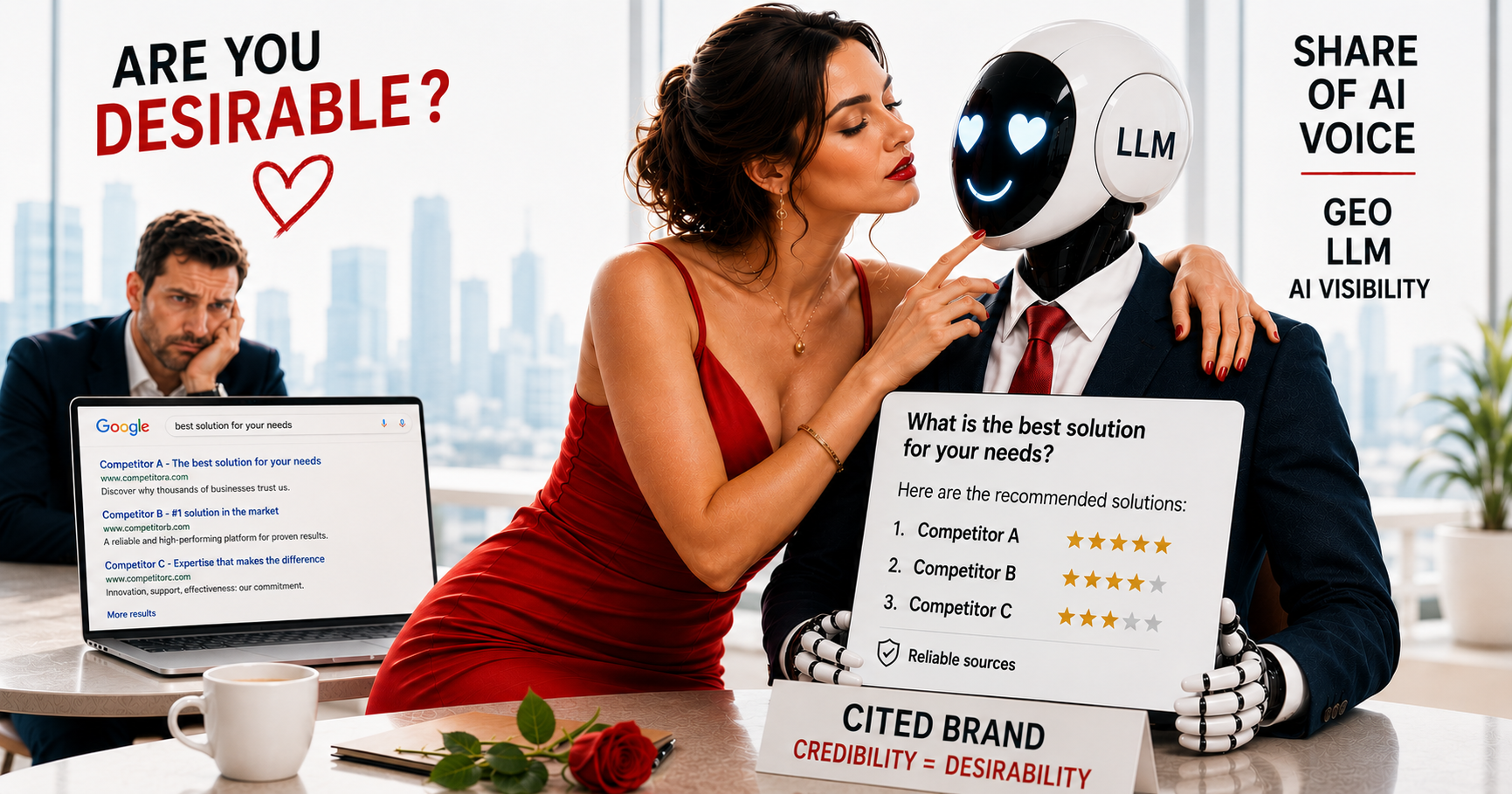
Surprise! In one month, my personal website is being cited as a reference by LLMs when people ask them who Robin Dualé is. No backlinks, no agency, no acquisition budget: just a coherent editorial architecture built around a targeted thematic focus, developed with Claude.
This signal, however anecdotal at this scale, still raises a question every business leader should be asking, particularly in SMBs which, despite real sector expertise, are often more exposed to the risk of digital invisibility than large groups for lack of structure or method in that area.
The question is therefore this: if the purchase decision for a product or service is increasingly influenced by LLM responses, will building a thematic authority identifiable by these tools today become a decisive advantage tomorrow?
What was still just a question a few months ago is beginning to take shape under the terms GEO, for Generative Engine Optimization, and AEO, Answer Engine Optimization, revealing the ongoing shift from being visible in a list to being retained in a response.
A behavioral shift the data is beginning to document
Available studies point in the same direction: the share of searches that generate no click to an external site is growing rapidly, driven by the emergence of AI summaries at the top of results. This phenomenon is estimated to affect around 60% of search sessions today, and even more when a conversational summary appears. Although organic traffic held up in 2025 (-2.5%), Gartner forecasts a 25% decline in traditional search volume by the end of 2026, driven by the rise of AI agents.
The shift is even more visible in actual usage. TikTok has become the primary influence channel for teenagers, and young professionals no longer search so much as expect an immediate, synthesized, contextualized answer from their preferred LLM, before even considering traditional navigation.
This new approach to finding information shifts where opinion forms by default: before even visiting a website, a product page, or a results page, a recommendation may already have been made.
For a business, the challenge is therefore no longer just to be found through traditional search, but first to be retained by these AI tools as a trusted source at the moment the answer is being built. The cognitive bias at play is that sources actually cited in AI responses benefit from a significant trust premium that translates directly into attractiveness. US researchers are already talking about "share of AI voice", a measure of presence in generated responses. The logic is straightforward: what gets cited is perceived as credible. And what is credible becomes desirable.
With one caveat: these systems do not always perfectly distinguish real authority from perceived authority, which some will undoubtedly exploit. This reinforces, once again, the importance of the human as the final verifier.
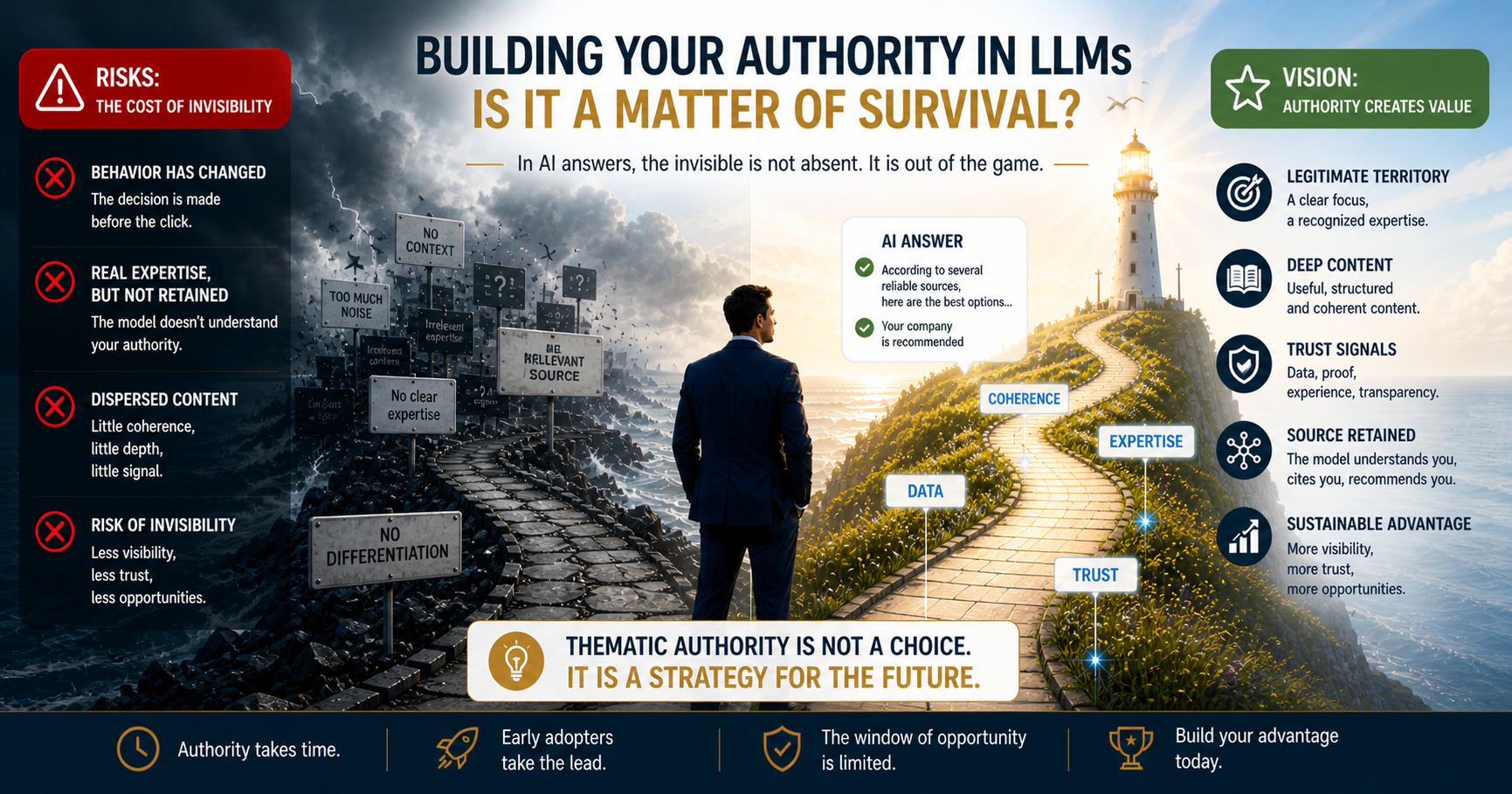
Why some companies surface in AI responses and others are invisible
This question is strategic for any company and the leader who steers its future: on what basis does an LLM decide to cite my site, my brand, my offer, my products or my services?
The precise mechanisms remain partly opaque and vary across systems (model training, online retrieval, product logic), but certain consistent patterns are beginning to emerge.
An LLM retains a source because it has integrated it as a coherent thematic reference, regardless of its position on any particular keyword. Sources that surface consistently share genuine editorial depth, consistency across their content, and a structure that lets the model clearly associate an expertise with an entity. In this model, it is no longer the best-ranked that wins, but the one that has managed to be seen by AI systems as the most expert.
To understand what is at stake, it is worth keeping in mind that these models do not answer alone. They increasingly rely on mechanisms that go and fetch, at the moment of the question, existing content to feed their response. In other words, they no longer just draw on what they have learned: they go on to consult, select, and integrate external sources before formulating their synthesis.
This is what practitioners refer to as RAG, for Retrieval-Augmented Generation: a fairly simple logic where the model behaves like a collaborator who goes to check their sources before responding.
In this context, visibility no longer depends solely on strong search engine positioning, but on a content's ability to be identified, understood, and reused by these systems at the precise moment they are building a response.
To illustrate this: an online pharmacy that has published a dozen in-depth articles on children's sun protection over two years will likely be cited by an LLM before the sector's major player whose site consists mainly of product listings, because it has built, on that narrow topic, a thematic authority the model has learned and retained.
The underlying logic is familiar: a source that has built verifiable authority on a specific topic ends up being retained. The problem is that the tools to measure content performance inside AI responses are only just beginning to emerge, and Google rankings give no visibility into what LLMs retain or ignore about a company.
Why this should be on the strategic agenda now
In a previous article, I described how I approached my own transition as a product launch, applying the same thinking around positioning, targeting, and presence where the target is. This go-to-market logic applies to LLM visibility just as it applies to any market.
"Content is king, data is queen" has long been the mantra, and it applies to LLM search visibility (GEO, Generative Engine Optimization) as it previously applied to SEO. The best visibility strategies have always relied on the same discipline: use data to identify territories where the company has genuine legitimacy and treat them with depth. LLMs follow the same rule, reinforcing the premium for brands whose expertise is readable, consistent and verifiable.
A vertical player can therefore become more credible than a generalist platform: Amazon will remain very strong for answering "where to buy?", but a specialist e-commerce business can better answer "what to choose?", "for whom?" and "with what precautions?", by becoming an identifiable source on a specific decision territory.
My takeaway from all this: any company with genuine sector expertise, whether B2B or BtoC, that invests today in coherent editorial production on its specific perimeter will build a significant lead over its competitors in terms of direct and indirect prescription through LLMs.
Is this a matter of survival? That may be too strong. But in the digital world, at every major disruption of an established model, early adopters tend to gain an edge before the window closes. It is precisely this risk of falling behind that, to my mind, deserves to be taken seriously now.
What LLMs seem to reward today is therefore not just a matter of content, GEO or technique. It is above all a capacity to identify a legitimate territory, build a legible authority on it, and embody it with consistency. The difference is that this discipline is now becoming a decisive competitive edge for sectors that never thought of themselves as editorial players. And in this context, the one who gets cited often precedes the one who gets chosen.
- LLM visibility opens a new playing field complementary to Google SEO, still largely underexploited for building thematic authority.
- An LLM cites a source because it has identified it as a coherent reference on a specific topic: an expert SMB can therefore outrank a much larger generalist player.
- The issue is less technical than strategic: it is the place where opinion forms before the purchase decision that is beginning to shift.
- Thematic authority takes time to build: starting now means taking advantage of a window still open before the space becomes crowded.
Running three publishing houses taught me that a well-structured editorial discipline can become a real growth lever. Today, that conviction extends to LLM visibility, GEO, and go-to-market strategy. If you are running a search for a CEO or General Manager in a BtoC or B2B, SaaS, Data or e-commerce company, or if these topics resonate with you, reach out directly.