
In my experience, the arrival of a financial investor is often the moment when many CEOs realise they did not know all the rules of the game. The operational rules, yes, the rules of the capital structure, rarely.
By capital structure, I mean something broader than the strict accounting definition: the full set of financing, governance and alignment mechanics that structure the relationship between an investor and a CEO. Who bears which risk, who gets repaid first, who can block a decision, under what conditions does the management team benefit from the value created?
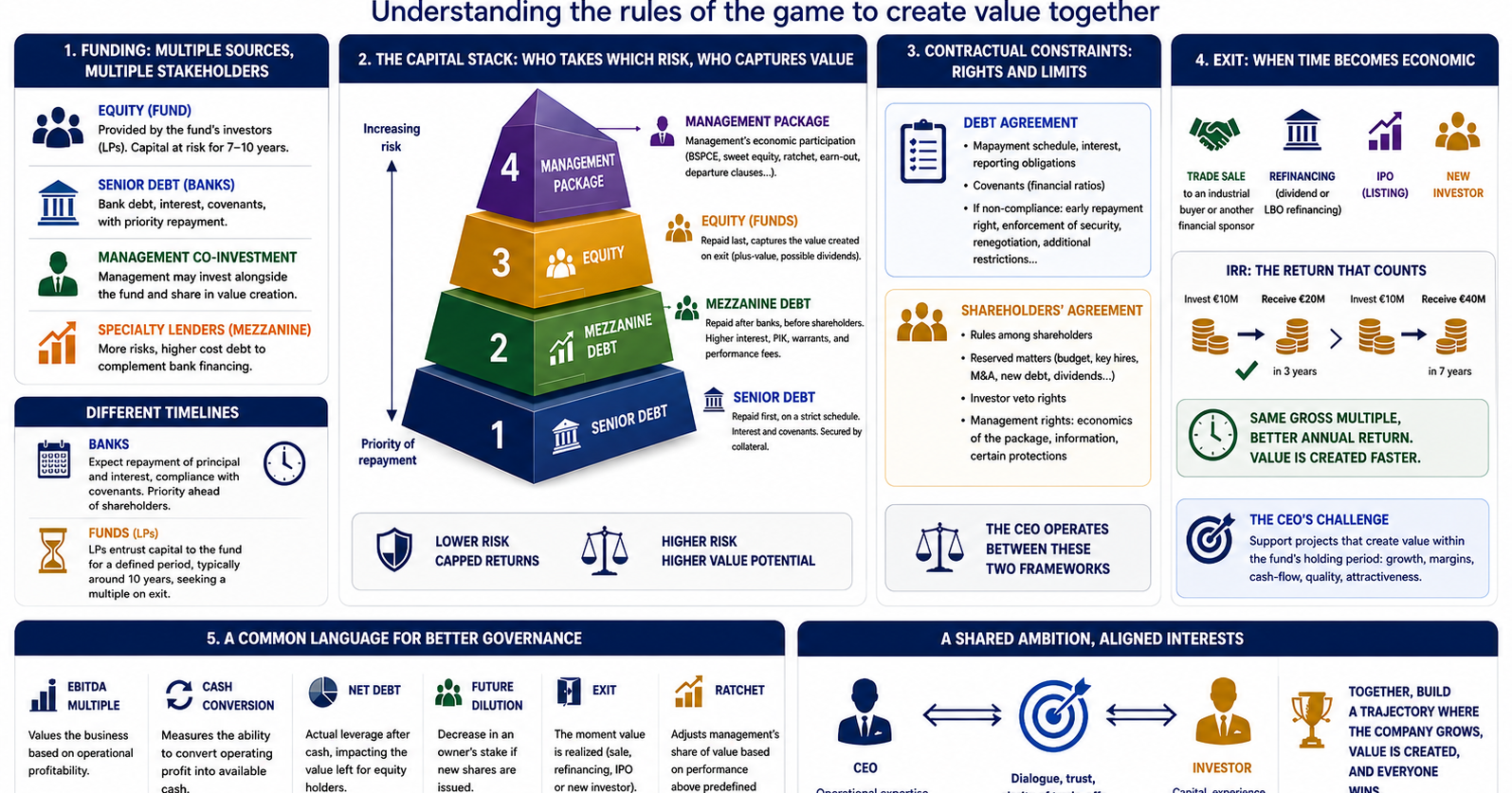
Financing, capital structure, contracts, management package, exit mechanics: understanding these dimensions makes board decisions more legible, clarifies areas of tension and facilitates day-to-day governance.
The different sources of financing
The arrival of a fund changes the decision-making framework because it brings in several new stakeholders, each with their own reading of the company's priorities. Each brings a different resource, their own expectations around value creation, their own timeline, their own rights and their own definition of risk.
An investment transaction typically combines several sources of financing:
- The fund contributes equity, drawn from the capital entrusted to it by its own investors.
- Part of the financing frequently comes from banks, in the form of debt.
- In some structures, specialist lenders provide additional financing through debt that is riskier and more expensive than standard bank debt.
- Management may also co-invest alongside the fund, depending on the deal.
The fund's investors are called LPs, or Limited Partners. They may be insurers, pension funds, family offices or other institutional investors. They entrust their capital to the fund for a defined period, typically around ten years.
Behind this combination of financing, each stakeholder introduces their own timeline into the company's governance:
- Banks expect repayment of their debt, payment of interest and compliance with certain financial commitments set out in the loan agreement. These commitments, known as covenants, allow lenders to track the company's financial trajectory. The bank's repayment schedule is generally strict, and their senior ranking places them ahead of shareholders in the repayment order.
- The fund operates on a different timeline. It must return the capital entrusted to it by its LPs, ideally with a multiple, within the fund's lifetime. This return depends on the value created after accounting for debt, interest, any refinancings and the exit value.
Assembling the financing is only a first step. Behind any fundraising round or acquisition, another question is central: in what order is risk borne, and how will value be distributed among the different stakeholders if the transaction succeeds -- or if it comes under pressure.
The layers of capital: who takes which risk, who captures value
These sources of financing do not carry the same risk, are not repaid at the same time, do not capture value in the same way and do not carry the same rights. Their order within the structure explains much of the behaviour at board level.
The capital structure works like a layered stack. Each layer corresponds to a level of risk, an expected return and a repayment priority. The logic is straightforward: the less risk a layer takes, the more constrained its return; the more it accepts being repaid later, the greater the share of value it can capture.
First comes senior debt.
- This is typically the main bank financing. It is often secured by collateral and subject to a strict repayment schedule. The bank earns primarily through interest, arrangement fees and sometimes commissions. Its senior ranking generally makes it the cheapest layer of financing, though its weight on cash flow can become significant when rates are high or when the company still needs to fund its growth before generating the expected cash.
This debt is repaid from available cash. Interest must be paid, maturities must be met and the financial ratios set out in the loan agreement must remain within the thresholds agreed with the bank. These ratios reflect the commitments made at the time of financing and the sound execution of the plan presented to lenders.
When a significant portion of the transaction is financed by bank debt - what is often called an LBO (leveraged buyout) - cash becomes a central concern. This is one of the reasons the expression cash is king takes on a very concrete meaning in this type of structure: accounting profit is not enough. The ability to generate cash and repay debt on schedule determines management's credibility with lenders and preserves its room to manoeuvre. When cash tightens, the nature of the dialogue changes: oversight intensifies, decisions become more constrained and the bank can reclaim a central position in the balance of power.
Above that may sit mezzanine debt.
- It is provided by specialist lenders when standard bank debt is insufficient or when the transaction requires additional financing. These lenders are often private debt funds, mezzanine funds or management companies specialising in acquisition financing. This intermediate debt accepts more risk than senior debt: it is repaid after the banks but before shareholders. In return, it commands a higher price, through a higher interest rate, sometimes capitalised interest, fees, or in some cases a share in the transaction's performance.
At the top sits equity, or share capital.
- This corresponds to the funds contributed by the fund, sometimes alongside management or other shareholders. It is the most exposed layer, as it is repaid last. In return for this risk, equity captures the value created beyond the repayment of debts. This value is realised primarily at exit, in the gap between the capital invested and the sale price achieved. Dividends may also be distributed if the structure allows.
Alongside financial equity sits a particular layer: the management package.
- It groups together the instruments and clauses that organise management's economic participation in value creation. It is the layer that links the CEO's operational role to a financial stake in the exit. Its mechanics and instruments are covered later in this article.
Understanding this hierarchy allows for a clearer reading of the board's decisions. The lender seeks protection of repayment. The investor seeks value creation within a defined horizon. Management seeks to develop the company while preserving its capacity to act, its economic alignment and recognition of its contribution to the value created at exit.
The contractual constraints: covenants and shareholders' agreement
The layered structure explains who finances, who takes the risk and who captures the value. It extends into the contracts that frame everyone's rights. For the CEO, two documents become particularly structuring: the debt agreement and the shareholders' agreement.
- The debt agreement governs the relationship with the banks. It sets out the repayment schedule, interest, reporting obligations and covenants. These covenants are the financial commitments already mentioned: they allow lenders to verify that the company remains on the trajectory on which the financing was granted.
Their logic is binary. At a given date, either the ratios are met or they are not. In the event of a breach, the bank does not automatically become the owner of the company. It does, however, hold significant contractual rights: accelerated repayment of the loan, enforcement of collateral, renegotiation of terms, margin increases, additional restrictions. The balance of power shifts.
- The shareholders' agreement governs a different level of power. It sets the rules between shareholders: who decides what, with what majority, within what timeframes and with what protective rights. In practice, it may govern the approval of the annual budget, the appointment or replacement of key executives, the completion of an acquisition, the raising of new debt, the distribution of dividends or the conditions of a sale.
Not all shareholders carry the same weight. Minority shareholders, including management when it co-invests, often have economic rights and sometimes information rights, but rarely a blocking power over structural decisions. Their influence comes more from their operational role, their possible presence on the board or their relationship with the investor than from their percentage of capital.
Two mechanisms play a central role, primarily for the benefit of the financial investor.
- Reserved matters are decisions that require the investor's explicit approval: budget, key hires, M&A, refinancing, dividends, exceptional transactions.
- Veto rights give the investor the ability to block certain decisions, even as a minority shareholder. These protections are rarely granted to minority management shareholders, whose rights more often relate to the economics of the package, information or certain exit conditions.
The debt agreement and the shareholders' agreement can intersect during periods of stress. Difficulty in meeting covenants can trigger a renegotiation sequence with the banks and heighten the investor's focus on key decisions. Conversely, in a lightly leveraged structure, the shareholders' agreement often becomes the primary constraint framework for the CEO.
The debt agreement protects a lender. The shareholders' agreement organises power between shareholders. The CEO operates between these two frameworks.
Once the relationships between lenders, investors and shareholders are established, another equally structuring question arises: how to align those who finance the company with those who run it day to day. That is precisely the role of the management package.
The management package: what alignment with the investor actually means
The management package is often presented as a tool for alignment between the CEO, the management team and the investor.
- For the CEO, the subject goes beyond variable compensation. The management package defines how they can capture a share of the value they contribute to creating. It transforms part of their role into financial exposure: if the company's value grows, they can capture a share of it; if the trajectory deteriorates, that participation may lose much of its economic interest.
- For the fund, the interest is symmetrical. A CEO who invests personally, or whose significant portion of compensation depends on the exit value, shares part of the economic risk. They are no longer managing purely as an operational representative, but also as a shareholder exposed to the same value creation. This alignment does not eliminate potential disagreements, but it narrows the incentive gap between the party financing the transaction and the party running it day to day.
Beyond the bonus, the management package links management's financial compensation to the investor's exit mechanics. It defines the conditions for the CEO's participation in value creation: horizon, trigger thresholds, instruments, departure clauses.
Depending on the case, these instruments give access to shares, share rights or a portion of future capital gains, under conditions fixed in advance. Management then benefits from value creation if the company's trajectory and exit price exceed the agreed thresholds. These rights may vest progressively, or depend on conditions of tenure, performance or liquidity. The logic remains the same: linking the executive's economic participation to the duration of their commitment and the value actually created.
These mechanisms can take several forms depending on the company, the executive's profile and the legal documentation of the transaction.
- BSPCE (French founder warrants) give the right to subscribe to shares at a price fixed at the time of grant, under a specific and often favourable tax regime, subject to strict eligibility conditions that are regularly amended by finance laws.
- Sweet equity allows management to subscribe to shares at a discounted price or on preferential terms, in exchange for a commitment over time.
- The ratchet works as a performance accelerator: the more the investor's capital gain exceeds certain thresholds, the greater the share of the surplus the CEO can capture.
Alongside these instruments, the earn-out plays a related but distinct role. It is a supplementary price paid after a sale, conditional on achieving objectives defined over a given period, often twelve to twenty-four months. It concerns the CEO as a selling shareholder more than as an employee, and is a negotiating subject in its own right within the sale documentation.
The most sensitive clause often remains the good leaver / bad leaver provision. It defines what happens if the CEO leaves the company before the investor's exit.
- A good leaver generally covers a non-fault departure: illness, death or sometimes a strategic disagreement not attributable to the executive. The CEO retains all or part of their rights, according to a defined schedule.
- A bad leaver covers resignation, gross misconduct, serious fault or breach of the shareholders' agreement. The CEO may then lose unvested rights and have their shares bought back at terms very unfavourable relative to their real economic value.
The line between the two is negotiated at signing. It then becomes one of the hardest points to reopen.
All these mechanisms take on their full meaning at the time of exit. That is when the effects of the financial structure, the negotiated clauses and the incentive arrangements put in place all materialise.
The exit: the moment when time becomes an economic variable
After the structuring of financing, the contractual rights and the management package, the exit is the moment when all of these mechanics converge. The order established in the structure determines who gets what, when, and under what conditions value flows back to shareholders and management.
For the fund, this sequence raises another central question: at what point will the value created be realisable.
It is in this context that the fund measures the performance of its investment. The amount recovered matters. The time needed to recover it matters too. From this arises the central metric of the trade: IRR, or Internal Rate of Return. It measures the performance of an investment by accounting for time.
For an operational executive, this logic can seem counter-intuitive. A fund that invests €10m and recovers €20m in three years has doubled its money. The amount recovered is less than a fund that would recover €40m in seven years. Yet the first scenario shows a better annual return, because value is created much faster. IRR privileges this speed of value creation.
Time therefore becomes an economic variable. For a fund, the value created depends on the amount recovered at exit, but also on when that exit occurs. The same gain does not produce the same return whether it is achieved in three, five or seven years.
This constraint reshapes the reading of strategic projects. A growth, transformation or acquisition project will more easily be supported if it improves the company's value within the fund's holding horizon: more legible growth, strengthened margins, more predictable cash flow, reduced dependency on a few clients or better attractiveness to a future acquirer.
A strategically sound project can therefore become harder to defend if its economic effects appear too late. The board discussion then covers two dimensions: the quality of the project and its contribution to the company's value within the investor's timeline.
What this changes about how to govern
Understanding the capital structure does not change the CEO's operational role. But it changes how decisions are prepared, how board dialogue unfolds and how to anticipate the moments when finance can constrain or accelerate execution.
A CEO is not expected to master every financial mechanism the way a fund does -- that is its business. But some concepts become essential for understanding the logic of exchanges with the investor and the board, and how the company's trajectory is read.
That is especially true of a few indicators and mechanics used to read performance, risk and value creation.
- The EBITDA multiple expresses the company's value as a function of its operating profitability. An improvement in EBITDA or in the quality of that profitability can directly affect the exit value.
- Cash conversion measures the company's ability to turn operating profit into available cash: it conditions debt repayment and the plan's credibility with lenders.
- Net debt indicates the real level of indebtedness after accounting for available cash, and influences the value that will remain for shareholders once debts are repaid.
- Future dilution refers to the reduction in a shareholder's stake if new shares are issued.
- The exit is the moment when value created is realised for the investor, whether through a sale, refinancing, IPO or the arrival of a new shareholder.
- The ratchet adjusts the share of value captured by management according to performance: it can accelerate the gain if agreed thresholds are exceeded, though its effects depend heavily on the documentation negotiated.
These concepts make exchanges with the investor more direct, more factual and more useful to the board. They allow operational topics to be connected to their financial implications: investing, hiring, acquiring, divesting or preparing the next growth phase.
The relationship then becomes more fluid. The CEO brings knowledge of the market, the organisation, clients and the operational rhythm. The investor brings a reading of the capital, growth scenarios, liquidity requirements and exit conditions. Trade-offs are discussed more easily, areas of tension are anticipated better. Governance gains in confidence, speed and ambition.
The capital structure offers a reading of power, risk, time and economic alignment. Used as a shared language, it strengthens collaboration between CEO and investor and provides a concrete framework for a shared ambition: to build a trajectory where the company grows, value is created, and every party comes out ahead.
To go further on exit dynamics in a PE context, see the article Successful exit: what buyers really look at.
- The capital structure gives the CEO a framework for reading power, risk, time and value creation across banks, investors, management and shareholders.
- Each layer of capital (senior debt, mezzanine, equity, management package) carries a different risk, earns a different return and influences board behaviour.
- Covenants and the shareholders' agreement frame the CEO's room to manoeuvre: the former protects lenders, the latter organises power between shareholders.
- The exit gives the whole structure its economic meaning: IRR, the fund's timeline and the management package align decisions around a shared ambition for value creation.
I am available for a CEO or Managing Director mandate in a B2B SaaS, BtoC, Data, AI or e-commerce company between €10m and €100m. If you are conducting a search or would like to discuss these topics, feel free to reach out directly.