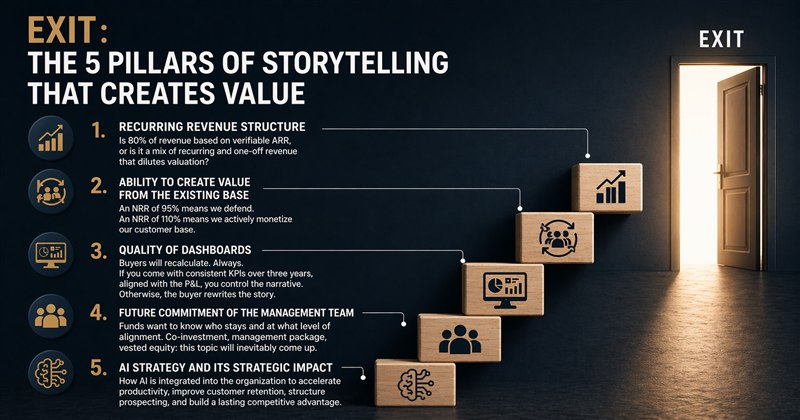
Six exits completed. Five acquisitions made. Hundreds of teasers and information memoranda reviewed. That dual experience, as both seller and buyer, taught me one thing: in due diligence, growth slides never tip the decision. Five checks do. The structure of recurring revenue. The ability to create value on the existing customer base. The quality of the dashboards that tell the story. The clarity around the future commitment of the leadership team. And, today, the AI strategy and its real impact on value creation.
The myth of the great story
We all love telling great stories. Growth trajectory, strategic vision, differentiated market positioning. These things matter. They open conversations, generate initial interest, and justify an attractive multiple.
I have never seen a single company present a declining forecast plan. Even when a company was on a downward trend, the plan presented miraculously reversed the curve. As if the magic of a change in ownership would put the company back on a growth track.
What buyers are actually looking for is not a growth promise. It is the credibility of the plan behind it. A clear strategy. A precise action plan. Identified investments. A defended product roadmap. External growth options. A sales organization sized to execute. When these elements are aligned, the great story becomes credible. When they are missing, confidence in the project fades quickly.
First signal: the structure of recurring revenue
For subscription-based companies, the first thing any buyer verifies is the composition of revenue. Not the total amount. The split between what is recurring and what is not.
One euro of ARR does not carry the same value as one euro of spot revenue. A company reporting 10 million in revenue can be worth a multiple of 3x or 8x depending on whether that revenue is 30% ARR or 90% ARR, a ratio to be calibrated against sector and product type.
Buyers systematically request the precise breakdown: recurring subscriptions, one-time services, setup fees, exceptional revenue. They reconstruct the real ARR. They verify consistency with contractual renewals. They identify revenue that is dressed up as recurring but is not.
This preparation cannot happen three months before the exit. It is built over the entire duration of the role, by progressively migrating customers to 100% subscription models, eliminating non-recurring setup fees, and clarifying contracts. This is what I did in my previous roles. And it is that work that made it possible to present clean, verifiable, and valuable ARR.
Second signal: the ability to create value on the existing base
The second metric every buyer scrutinizes is NRR: Net Revenue Retention. Is the company capable of creating value on its existing customer base, or is it simply defending it?
An NRR of 95% says: we are defending. An NRR of 110% says: we are actively monetising our customer base. That is not the same story. It is not the same valuation.
Buyers reconstruct NRR over three years. They identify the levers: price increases, upselling, additional module sales, geographic expansion within accounts.
A mature organization is one where revenue grows naturally on the installed base. Where products drive innovation that creates genuine value for customers, enabling sales teams to develop existing accounts while acquiring new logos.
Third signal: dashboards that tell the story before the slides do
Buyers will recalculate. Always. They will restate the P&Ls, reconstruct cohorts, recalculate churn, verify ARR. That is their job.
But there is a meaningful difference between a seller who arrives with clear, documented, traceable dashboards, and one who arrives with financial statements hoping the buyer will not ask too many questions.
In the first case, the seller controls the narrative. They present their view of the metrics, justified, consistent, easily verifiable. The buyer recalculates, confirms, and moves forward. In the second case, it is the buyer who rewrites the story. They build their own dashboards, with their own assumptions and adjustments. And that version is always less favorable.
The rule is simple: every KPI must be reconstructed using the same methodology across at least three years. ARR by cohort. Monthly NRR. Churn in value and volume. CAC and LTV consistent with CRM data.
No methodology changes over the review period. No sudden restatement that miraculously improves the current year's numbers.
Buyers do not want a snapshot. They want a trend. And that trend is only readable when KPIs are comparable year after year, without methodological breaks. Dashboards must align with P&Ls, with no unexplained gaps. This is not cosmetic. It is credibility.
Fourth signal: clarity around the future commitment of the leadership team
Another element every buyer verifies systematically is the leadership team. Funds need to understand who the key people are and what the management team wants in terms of future investment.
This question does not come up in the abstract. It comes up contractually. Buyers want to know who is staying, for how long, and with what level of commitment. And they want to make sure everyone is aligned.
The mechanisms exist. Management packages for senior executives. Time-vested equity for key individuals who will accompany the company through the next exit. These structures are not legal details. They are the signal that the team believes in the project, and accepts tying their compensation to future value creation.
This cannot be put together in the final weeks of a negotiation. It is built from day one of a new role.
Fifth signal: the AI strategy and its impact on value creation
When I ran my first exits, no one asked about AI strategy. Today, it comes up systematically in due diligence. Not as a checkbox, but as a genuine valuation lever.
The question buyers ask is not "do you use AI?" It is more specific: how is AI integrated into the organisation to create measurable value? Accelerating team productivity, improving customer retention through early warning signals, structuring commercial prospecting, reducing the marginal cost of service delivery. These concrete, quantified, defensible use cases change how acquirers perceive growth and margin potential.
A credible AI strategy is also a signal about organisational culture. A leadership team that has already embedded these tools into its processes is perceived as a team capable of executing the next phase of value creation. That argument carries extra weight when industrial acquirers are often looking to accelerate their own digital transformation through the acquisition.
This is not something to improvise as the transaction approaches. An AI strategy that creates lasting competitive advantage is built over time: tool selection, team training, workflow integration, gain measurement. Acquirers distinguish between a narrative and an operational reality.
When to start preparing
The question always comes up: when should you start preparing for an exit?
The answer is straightforward: from day one.
Exit preparation in a PE context is a discipline that starts at the beginning of a role. Because the exit is an inseparable part of the story of any PE acquisition. The timing may shift, but the exit will come.
Migrating revenue to a 100% recurring model. Building an offering that generates positive NRR. Constructing dashboards that are consistent over three years. Clarifying the future commitment of the leadership team. Deploying an AI strategy that creates measurable value. These things are not prepared eighteen months before the exit. They are built throughout the entire tenure.
A successful exit is not won in the final months. It is won through daily discipline. Operational cleanliness. A culture of measurement and transparency.
And that is exactly what a strong CEO does naturally, even without an imminent exit in view. Because an organization ready to be sold is also, by construction, an organization ready to create value in a recurring and scalable way.
This article focuses on value creation levers through organic development. Cost structure and EBITDA are naturally key elements of exit analysis and valuation, but they follow a different logic: operational optimization and profitability. That subject deserves its own dedicated treatment.
- Growth slides open the conversation but do not tip the decision. Five verifications build confidence: ARR structure, NRR, dashboard quality, clarity on the leadership team, and the reality of the AI strategy.
- The split between recurring and non-recurring revenue can drastically shift valuation multiples.
- A seller without documented dashboards leaves it to the buyer to reconstruct KPIs using their own assumptions. The story the buyer then writes is almost always less favourable.
- AI strategy has become a standalone value driver in due diligence. Buyers verify concrete use cases, quantified and embedded in operational processes.
To explore this leadership profile further, see the SaaS CEO under LBO page and active ownership. To understand the capital structure mechanics that shape the CEO-investor relationship leading up to an exit, see What I wish someone had explained to me about capital structure.
I am available for a CEO or Managing Director role in a BtoC or B2B, SaaS, Data or e-commerce company in a PE or family office context. If you are conducting a search, feel free to reach out directly.